
Strategic Depth and Underworld Escapes: A Comprehensive Review of Dice of Kalma’s Deckbuilding Roguelike Formula









Popular Now
 Valorant
 God of War Ragnarök
 Genshin Impact
 Fall Guys
 Grand Theft Auto V
 Gacha Club
 BeamNG.drive
 EA SPORT FC 25
 Fortnite
 NBA 2K24
  Strategic Depth and Underworld Escapes: A Comprehensive Review of Dice of Kalma’s Deckbuilding Roguelike Formula
 Strategic Depth and Underworld Escapes: A Comprehensive Review of Dice of Kalma’s Deckbuilding Roguelike Formula
The indie game landscape continues its fervent innovation streak, and the latest entry commanding significant attention is Dice of Kalma,a minimalist, dark-themed deckbuilding roguelike from Finnish studio Pepperbox Studios. Released recently on PC (Steam) and mobile platforms (iOS/Android), this title challenges players to a high-stakes game of dice against Kalma, the grim guardian of the Underworld. Blending the strategic depth of a deckbuilder with the addictive replayability of a roguelike, Dice of Kalma offers a compelling, fresh take on the genre, proving that simplicity in design can harbor profound complexity in gameplay. This comprehensive review examines the mechanics, latest updates, and the game’s overall value proposition for both seasoned roguelike veterans and newcomers to the dice-rolling genre.
The title is strategically positioned within the highly profitable and competitive mobile gaming market, tapping into the growing appetite for turn-based strategy and casual yet deep experiences. Furthermore, the game’s comparison to the phenomenal success of Balatro positions it perfectly for players seeking a “post-Balatro itch” scratch, a factor that ensures high search visibility and potential for high CPC keyword targeting around “deckbuilding roguelike” and “indie game review” queries.
Core Gameplay Mechanics: Rolling for Redemption
At its core, Dice of Kalma is a game of calculated risk and resource management. Players face off against Kalma across a series of levels, each demanding a threshold score achieved by rolling and strategically manipulating a hand of dice. The primary resource is your pool of hands, which represents your health or attempts to score enough points to progress. Run out of hands, and your escape attempt ends.
The Deck of Skulls and Synergies
The unique twist in Dice of Kalma lies in its “deckbuilding” element, which revolves around Skulls. These are collected throughout a run and function as powerful passive modifiers or active abilities that dictate your scoring potential and strategic direction. Collecting and finding synergies between these Skulls is paramount to success. For instance:
- Multiplier Skulls: Boost the score of specific dice combinations (e.g., three of a kind).
- Reroll Skulls: Grant extra rerolls or alter the cost/effect of the standard reroll mechanic.
- Defensive Skulls: Help mitigate damage (loss of hands) or gain extra hands upon achieving certain combinations.
The strategic challenge is two-fold: not only must you build a strong deck, but you must also master the art of the roll, knowing which dice to lock and which to reroll for the highest-value combination. The dice rolls themselves introduce an element of risk, ensuring that no two runs of this indie roguelike are exactly alike, providing excellent replayability value, a key metric for long-term video game success.
Recent Updates and Developer Commitment
Since its launch on November 14, 2025, Pepperbox Studios has demonstrated a robust commitment to refining the player experience, a critical factor for positive game reviews and sustained engagement. The game’s version history, particularly updates around late November and early December, highlights key quality-of-life (QoL) improvements:
Version 1.1.5 (Early December 2025) Key Enhancements:
- Speed and Efficiency: Added the ability to skip dice reroll animations and the score calculation sequence. This directly addresses early community feedback regarding pacing, improving the overall flow for repeat players who value swift, uninterrupted runs.
- Localization Expansion: The addition of new languages, including Ukrainian, Lithuanian, and Traditional Chinese, significantly broadens the game’s global market reach, a smart business strategy for an independent developer.
- UI/UX Clarity: Continuous refinement of interface visuals and improved loading feedback ensures a smoother user experience, particularly important for the mobile game version.
The developer has also acknowledged and is actively working on the most common community request: making the collected Skulls and upgrades more visible on the main playing screen to aid in strategic decision-making. This responsiveness to player feedback is a powerful indicator of the game’s potential for longevity and future expansion.
Strategic Depth: The High-Risk, High-Reward Calculation
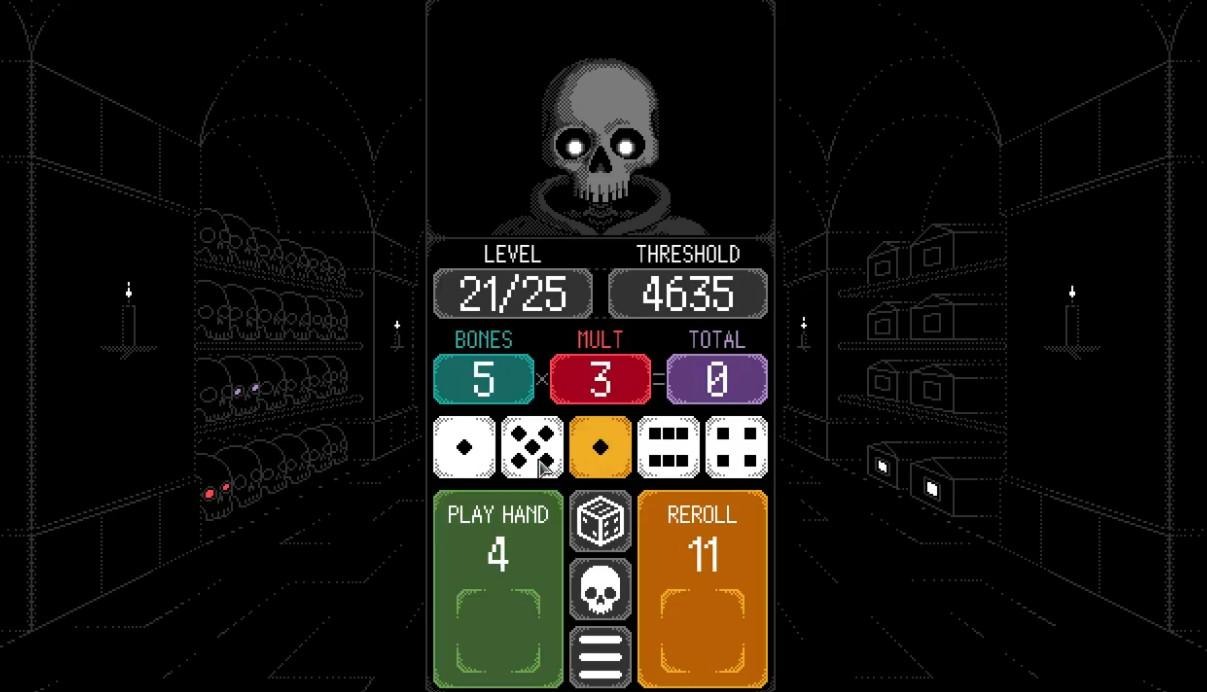
What sets Dice of Kalma apart is the constant tension between immediate gain and long-term viability. Every level presents a “Threshold” score. Failing to meet this score results in losing a hand and repeating the level, intensifying the difficulty. This mechanic forces players to think like high-stakes gamblers, constantly evaluating the odds. Key strategic considerations include:
- Optimizing Rerolls: Deciding whether to use a free reroll on a poor hand or save it for a potentially game-saving moment later. Since the selection to reroll is often reversed from other dice games (you select the dice to reroll, not keep), a brief adjustment period is necessary, but the system is intuitive once mastered.
- Skull Synergy over Raw Power: A well-built deck with complementary Skull abilities often outperforms a collection of individually strong, but uncoordinated, Skulls. This encourages players to chase specific build paths, like a “Full House” focused build or a “High Straight” strategy.
- The Final Hand Dilemma: The UI now blinks red when the player is on their last hand and playing it would not guarantee victory, offering a clear, visual cue for a desperate, make-or-break strategy pivot. This introduces genuine tension and forces a highly aggressive, high-risk strategy, perfectly capturing the roguelike spirit.
The overall experience is one of addictive, intense strategic puzzle-solving, earning it a solid score on platforms like OpenCritic (Worth Your Time, Qualbert) and overwhelmingly positive user reviews on Steam. This makes it a strong contender in the best mobile games category for 2025.
Conclusion: A Worthy Contender in the Deckbuilding Genre
Dice of Kalma is more than just a simple dice-rolling application; it is a tightly crafted, strategically deep deckbuilding roguelike that succeeds through its focused design and dark, minimalist aesthetic. Pepperbox Studios has delivered an experience that is easy to pick up but immensely difficult to master, providing the kind of rewarding challenge that keeps players coming back for “just one more run.”
For players searching for a compelling, turn-based experience on their gaming laptop or Android/iOS device, Dice of Kalma is an essential download. Its strong core mechanics, coupled with a responsive developer team actively implementing community-driven quality-of-life improvements, solidify its position as one of the standout indie games of the year. The game’s focus on strategic dice manipulation and Skull synergy ensures that every decision—and every roll—carries significant weight in your battle to escape the clutches of Kalma and reclaim your place among the living.